Why Your Google Ads Data Tells You Nothing (Without Proper Analysis)
An ecommerce founder showed me his campaign dashboard last week, proudly pointing to thousands of clicks and decent CTR. He thought everything looked great. When I asked which campaigns actually generated profitable sales, he went silent. He’d been tracking impressions and clicks for six months without once analyzing which ads drove revenue above their acquisition costs. His “successful” campaigns were actually losing ₹15,000-20,000 monthly, but he had no idea because he’d never looked beyond surface metrics.
This happens constantly. Businesses collect mountains of data, glance at basic numbers, and make million-rupee decisions based on incomplete analysis that completely misses what’s actually happening.
The Attribution Nightmare Nobody Solves
Here’s the fundamental problem with understanding advertising performance: customers interact with brands across multiple touchpoints before converting. Someone might see your display ad on Monday, click a Facebook post Tuesday, search your brand Thursday, then finally convert Friday after clicking a retargeting ad. Which channel deserves credit for that conversion?
Last-click attribution gives all credit to the final touchpoint—the retargeting ad—completely ignoring the three earlier interactions that built awareness and interest. This systematically undervalues upper-funnel channels while overvaluing bottom-funnel activities. You end up cutting budgets from campaigns that actually work while doubling down on campaigns that just capture demand others created.
First-click attribution does the opposite, giving all credit to that initial display ad. This overvalues awareness activities while ignoring that someone viewing a display ad once doesn’t mean they’ll convert without additional touchpoints pushing them forward. Most people need multiple exposures across different contexts before taking action.
Google removed four outdated attribution models in 2024 because they failed to accurately reflect modern customer journeys. The complexity of today’s buying process—which can involve anywhere from 20 to 500 touchpoints depending on purchase complexity—makes simple attribution models fundamentally inadequate. Yet most businesses still use last-click by default because they don’t understand the implications.
Data-driven attribution uses machine learning to analyze actual conversion paths and distribute credit based on how much each touchpoint statistically contributed. This sounds ideal, but it requires sufficient conversion volume to work properly—at least 300 conversions within 30 days for Search campaigns. Smaller accounts don’t have enough data for the algorithm to learn from, forcing them to use simpler models despite knowing they’re inaccurate.
Cross-channel attribution gets even messier. Google claims credit for conversions, Facebook claims credit for the same conversions, and email platforms claim credit too. Add them up and you’ve apparently gotten 150% attribution when logically that’s impossible. Each platform uses different attribution windows, tracking methods, and crediting rules, creating irreconcilable discrepancies.
The privacy regulations compound everything. GDPR and CCPA restrictions limit data collection and tracking across devices. Browser changes blocking third-party cookies make cross-device tracking harder. Users switching between phones, tablets, laptops, and desktops before converting creates fragmented journeys that attribution systems struggle to unify.
The Reporting Mistakes That Hide Reality
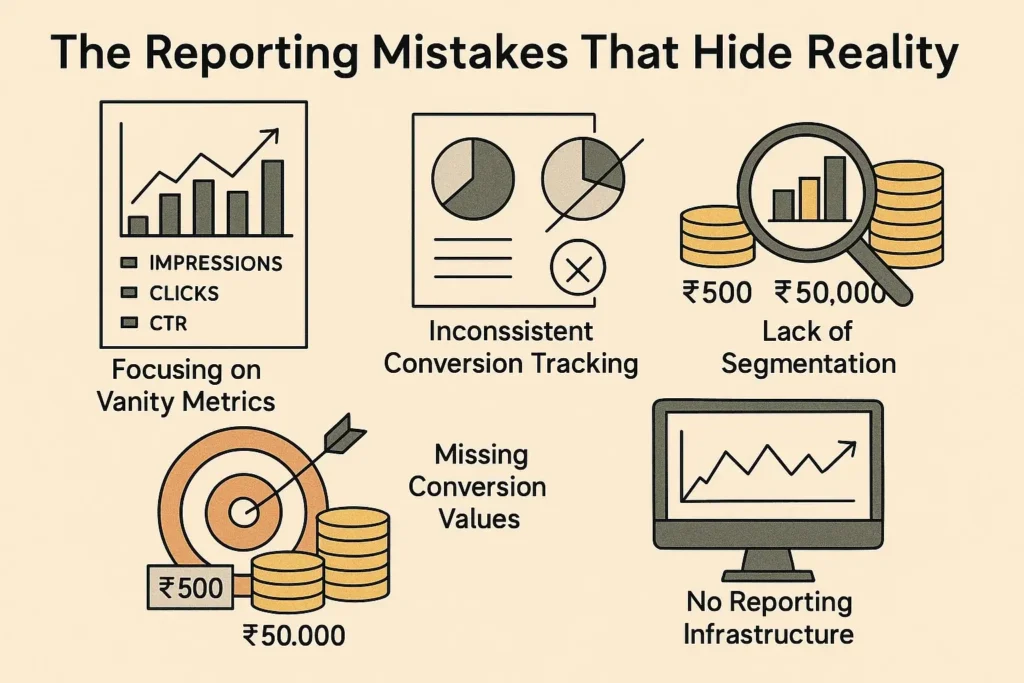
Even when businesses set up proper tracking, they make fundamental reporting errors that completely distort performance understanding. The most common mistake is focusing on vanity metrics—impressions, clicks, CTR—that look impressive on paper but don’t correlate with business outcomes.
I see accounts celebrating 5% CTR improvements while ignoring that conversion rates dropped 30% in the same period. They’re paying for more clicks that convert worse, meaning they’re actually losing money while metrics they track suggest success. Without connecting data to actual revenue and profitability, you’re just watching numbers go up and down without understanding what they mean.
Inconsistent conversion tracking creates another huge problem. Some campaigns track page visits as conversions, others track form submissions, and still others track actual purchases. The algorithm optimizes different campaigns toward completely different goals, making performance comparisons meaningless. You think Campaign A outperforms Campaign B, but really they’re measuring entirely different things.
Missing conversion values prevents proper optimization for ecommerce businesses. If you don’t pass transaction values to the platform, the algorithm treats a ₹500 sale the same as a ₹50,000 sale. It optimizes for conversion quantity rather than revenue, which means you might generate lots of low-value sales while missing opportunities for high-value customers.
Many businesses don’t segment data properly either. They look at overall account performance without breaking down by campaign, geography, device, audience, or time period. A campaign might perform terribly on mobile but excellently on desktop, but combined metrics show mediocre results so nothing changes. Geographic analysis might reveal that one city converts at 10x the rate of another, but without segmentation you’d never know to focus budget there.
The complete absence of proper reporting infrastructure means insights get lost entirely. Businesses log into Google Ads once weekly, glance at a few numbers, and call it analysis. They don’t track trends over time, compare performance to benchmarks, identify anomalies early, or connect advertising data to business outcomes. Strategic decisions get made based on gut feelings rather than data-driven insights.
The Strategic Analysis Businesses Never Do
Beyond basic reporting, professional campaign management involves strategic analysis that most businesses don’t even know exists. Competitor benchmarking reveals whether your 3% conversion rate represents strong performance or indicates serious problems compared to industry standards. Without context, you have no idea if results are good, average, or terrible relative to what’s actually achievable.
Search query analysis identifies both waste and opportunity buried in mountains of data. Every week brings hundreds of new searches triggering your ads—some irrelevant that need blocking, others high-performing that deserve expansion into dedicated campaigns. Ignoring these patterns means budget slowly bleeds to irrelevant traffic while growth opportunities go unnoticed.
Audience performance analysis reveals which customer segments drive the most value. Maybe in-market audiences convert at 8% while cold traffic converts at 2%, suggesting you should shift budget allocation dramatically. Perhaps high-income demographics generate 3x higher transaction values, indicating that bidding more aggressively for those audiences would be profitable.
Device and location performance often varies wildly but gets ignored completely. Mobile might convert terribly but generate cheap awareness value that leads to desktop conversions later. Certain cities might deliver stellar results while others waste budget—but without geographic analysis, spending continues equally everywhere.
Hour-of-day and day-of-week patterns reveal when your audiences are most likely to convert. Running ads at full budget 24/7 wastes money during low-performing time periods when that budget could be reallocated to high-performing windows. But discovering these patterns requires analyzing performance data at granular time intervals most businesses never examine.
Attribution model comparison helps understand how different crediting approaches affect channel valuation. Running the same conversion data through multiple attribution models reveals which channels get overvalued or undervalued depending on methodology. This informs smarter budget allocation decisions based on understanding each channel’s true contribution.
Why Professional Management Transforms Data Into Strategy
This is exactly where a google ads agency provides transformative value businesses struggle to replicate internally. Professionals set up proper attribution models matched to business goals and customer journey complexity. They implement consistent conversion tracking across all campaigns with appropriate values assigned. They configure analytics properly so data flows cleanly and accurately.
The reporting infrastructure gets built correctly too. Agencies create custom dashboards highlighting metrics that actually matter for specific business goals rather than vanity numbers. They establish benchmark comparisons so you understand performance relative to industry standards and historical trends. They automate report generation so insights are delivered consistently without requiring manual data extraction.
Most importantly, professionals analyze data strategically rather than just presenting numbers. They identify trends before they become problems—spotting Quality Score degradation, CTR declines, or conversion rate drops early enough to fix them. They find opportunities hidden in granular data—high-performing audience segments worth expanding, geographic markets showing potential, time periods delivering outsized results.
Cross-channel analysis connects advertising data with business outcomes. Agencies track how influences Google search volume, how display campaigns impact branded search behavior, and how remarketing complements prospecting efforts. This holistic view reveals synergies and conflicts that single-platform analysis completely misses.
The data-driven decision making happens continuously rather than occasionally. When performance shifts, professionals investigate why immediately—has competitor activity increased, did seasonal patterns change, are ad fatigue setting in, did platform algorithm updates affect delivery?. They make informed adjustments based on understanding root causes rather than blindly reacting to metric changes.
Modern marketing requires first-party data strategies that businesses rarely implement properly. Agencies help build and leverage customer data platforms, implement proper CRM integration, create sophisticated audience segments from proprietary data, and use that intelligence to improve targeting and personalization. This becomes increasingly critical as third-party data access continues declining.
The Expertise Gap That Costs Money Daily
Campaign analytics has evolved far beyond logging in and checking if clicks increased. Today’s data-driven marketing demands sophisticated technical skills, statistical understanding, business acumen, and platform expertise most businesses don’t possess internally.
Research shows companies with advanced analytics capabilities achieve 15-20% higher marketing ROI and 23% better customer lifetime value optimization compared to those using basic analysis. That performance gap compounds month after month, with sophisticated competitors pulling further ahead while businesses using elementary analytics keep falling behind.
The platform complexity increases constantly. Google introduces new campaign types, attribution options, bidding strategies, and reporting features quarterly. Staying current requires dedicated attention that business owners focused on running their companies simply don’t have. Meanwhile, competitors working with agencies benefit immediately from expertise that adapts to changes as they happen.
Working with a google ads marketing agency closes this expertise gap through professionals who analyze advertising data daily across dozens of accounts. They recognize patterns instantly that would take DIY managers months to notice. They know which metrics predict problems before they become crises. They understand how different data points connect to reveal insights individual numbers can’t show.
The alternative is making critical business decisions based on incomplete analysis, flawed attribution, and surface-level metrics that miss what’s actually driving results. Smart businesses recognize that data analysis expertise isn’t their core competency, so they partner with specialists whose entire focus is extracting actionable intelligence from campaign performance.
Success requires transforming raw data into strategic insights that inform smarter decisions. The businesses that thrive aren’t just collecting data—they’re analyzing it expertly to understand what works, why it works, and how to do more of it. That level of sophistication separates campaigns that scale profitably from campaigns that burn budget while delivering mediocre results nobody fully understands.